 Adam Hafez
Key takeaways
- AI Performance entered public preview in Bing Webmaster Tools on 10 February 2026 and reports citations across Copilot, Bing AI answers and select partner integrations.
- Total Citations counts how often your content appeared as a source, without saying where in the answer it appeared.
- Average Cited Pages reports the mean number of unique pages from your site cited per day over the selected range.
- Grounding queries show the phrases the system used to retrieve the content, which is a different question from the phrases a person typed.
- Microsoft frames the report as an early step toward generative engine optimisation tooling, so treat the metrics as directional rather than as a ranking readout.
Bing Webmaster Tools now answers the question paid tools used to guess at: how often does an AI answer cite your pages. The AI Performance report, in public preview since 10 February 2026, shows citations across Microsoft Copilot, Bing’s AI-generated answers and, in Microsoft’s words, “select partner integrations.”
What it measures
Total Citations. How often your content was “displayed as sources in AI-generated answers” in the selected period. Microsoft is explicit this says nothing about placement: cited first or cited last count the same.
Average Cited Pages. The mean number of unique pages from your site cited per day, a breadth measure. It tells you whether a whole section gets used as source material or one page carries everything.
Grounding queries. The phrases the system used when it retrieved content that ended up referenced, not the question the user actually typed. Microsoft calls it a sample, not a complete list.
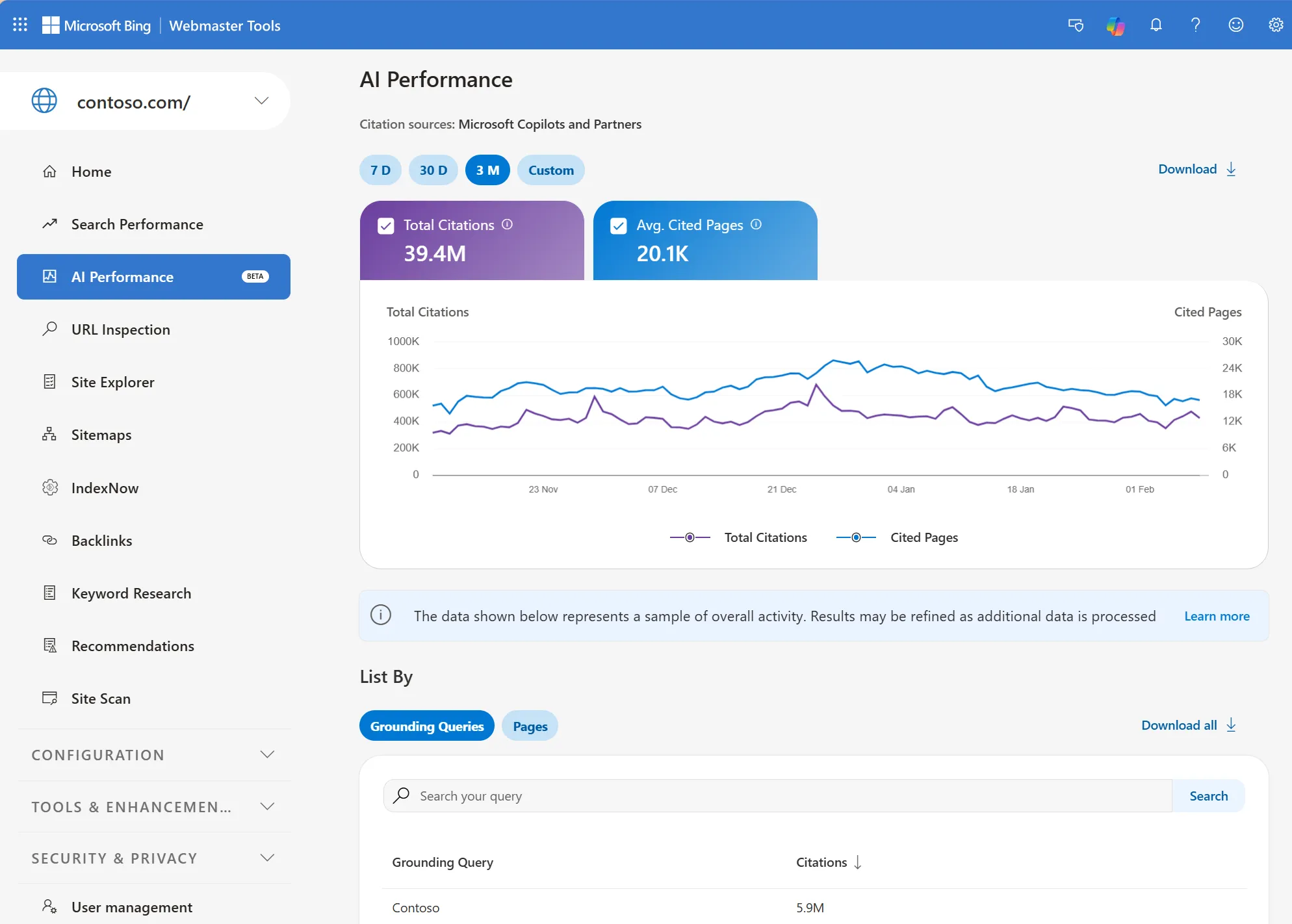
The AI Performance dashboard, from Microsoft’s own announcement. The domain shown is Microsoft’s placeholder example, not a real site’s data. Source: Bing Webmaster Blog.
Robots.txt still applies. Microsoft says the underlying retrieval “respects robots.txt and other supported control mechanisms,” so a page blocked from Bing’s crawlers cannot show up in this report, however often an answer would otherwise have used it. Low numbers are worth checking against your robots.txt before you read anything else into them.
How to use it without overreading it
Compare against your own baseline. Citations against your own impressions, not a competitor’s estimate: the absolute count depends on how much AI traffic Bing serves in your market, which you do not control.
Read queries as retrieval language, not keyword research. If the phrasing that pulls your page is consistently narrower than the topic you thought you covered, that is a content gap worth acting on in AI search.
Do not forecast traffic from it. Microsoft’s own framing avoids ranking language throughout, and nobody outside the engines can yet map a citation count onto sessions.
Why we care
A page can be the source an AI answer is built from and get zero clicks, a state invisible to every traffic report you already run. This is the first free, first-party number that describes it, even though it only covers Microsoft’s surfaces: Google still exposes AI feature performance through Search Console impressions rather than a citation metric, and the two numbers do not add together.
The evidence
- Type
- tooling
- Impact
- medium
- Affects
- AI answers, citations, reporting
Sources
- 1.Introducing AI Performance in Bing Webmaster Tools Public Preview - Bing Webmaster Blog, February 10, 2026Primary
- 2.Bing Webmaster Tools - MicrosoftPrimary
Frequently asked questions
Does Google offer the same thing?
Not in this form. Search Console reports impressions and clicks from AI features on your own property, but it does not count citations as a distinct metric or expose the query the system used to retrieve the page. Those are different measurements and they are not interchangeable.
What is a grounding query?
It is the phrase the AI system used when it retrieved supporting content, which is often a reformulation of what the person actually asked. Microsoft states the data shown is a sample, so treat it as a signal about retrieval phrasing rather than a complete query list.
Does a citation mean traffic?
No. A citation means your page was displayed as a source. Whether anyone clicked it is a separate question, and the citation metric does not answer it.
About the author

Founder
Founder, UpgradIQ, Inc.
Adam Hafez works on technical SEO and search measurement: how pages get crawled, indexed, ranked and now quoted by answer engines. He founded UpgradIQ, which reads Google Search Console and GA4 to tie ranking movement back to the changes that caused it. He publishes what the data supports and states the limits of it.
- Technical SEO
- Search Console and GA4 measurement
- Answer engine optimization
- Structured data
Related reading

Logging bug undercounted impressions in Search Console's AI report
A logging error cut reported impressions in Search Console's Generative AI report from August 13, 2026, Google says, with no real drop in visibility.

Search Console now reports impressions from Google's AI features
Google added a generative AI performance report to Search Console, showing how often your pages surfaced inside AI Overviews, AI Mode and Discover.
Search Console configures Performance reports from a prompt
AI-powered configuration turns a natural-language request into Search Console filters, comparisons and metric choices, no manual setup required.

Ahrefs: AI Overviews cut position-1 CTR by 58%
Ahrefs analyzed 300,000 keywords via Google Search Console and found AI Overviews now cut position-1 organic CTR by 58%, up from 34.5% a year earlier.