 Adam Hafez
Key takeaways
- Search Console reports impressions from generative AI features separately from ordinary search results, so AI visibility is finally measurable in first-party data.
- The Search report covers AI Overviews and AI Mode, and a second report covers generative AI features in Discover.
- Available dimensions include pages, countries, devices and dates down to hourly granularity, and both the chart and the table can be exported.
- As of 31 August 2026 Google says the reports reached every website worldwide, so an absent report now points at a property-level issue rather than a rollout stage.
Search Console now answers “how visible are we inside AI Overviews” with a real number instead of a shrug. The generative AI performance report separates impressions inside AI features from impressions in ordinary search results, and Google says it now reaches every website worldwide.
What the report contains
Impressions, broken four ways. How many times links to your site were shown inside a generative AI feature on Google Search, with pages, countries, devices and date dimensions down to hourly granularity. Both the chart and the table export.
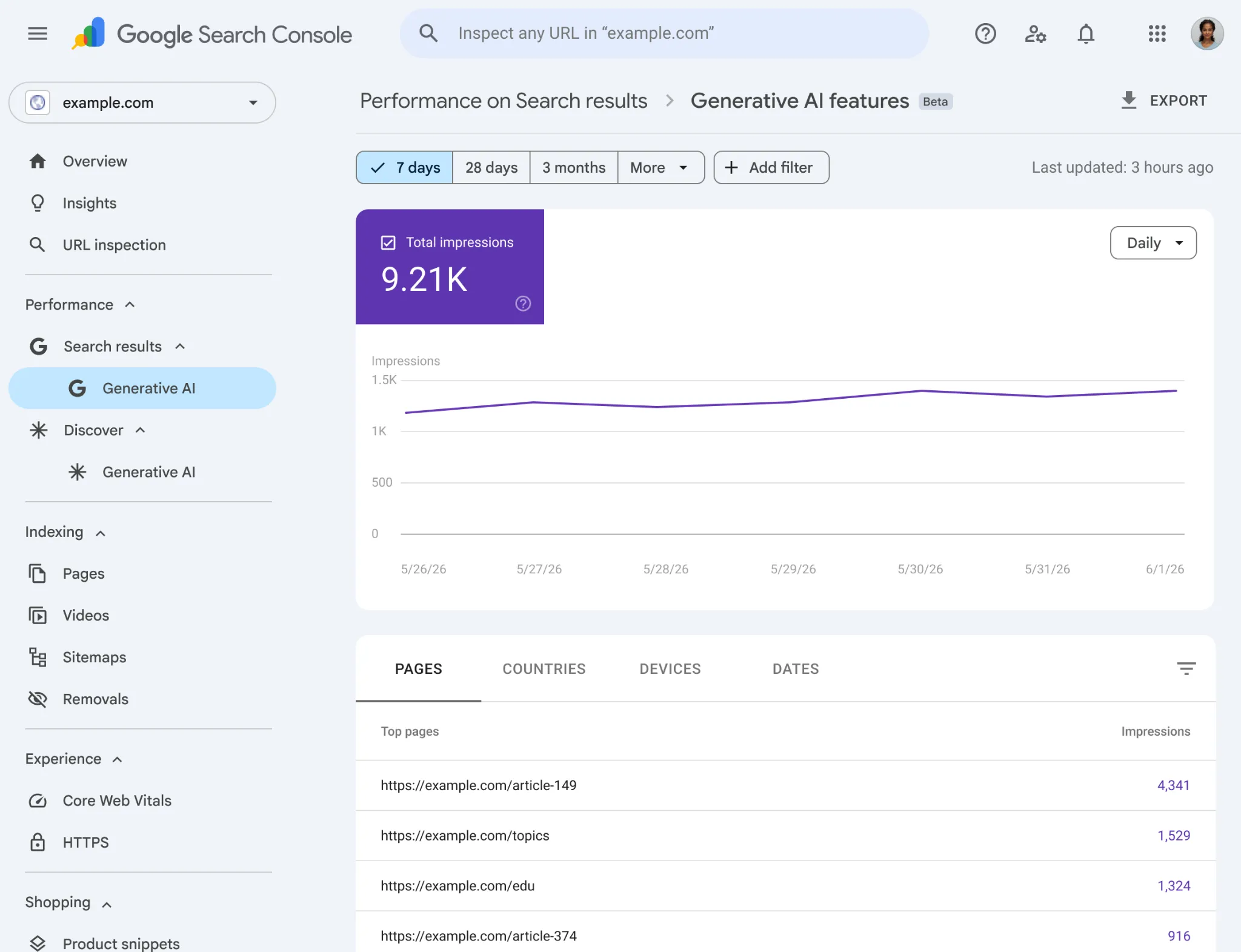
The report as Google shipped it, from the announcement post. The domain and numbers shown are Google’s own placeholder example, not a real site’s data. Source: Google Search Central.
Discover gets its own report. A second, separate view covers generative AI features in Discover, which matters for publishers whose Discover traffic behaves nothing like their search traffic.
The rollout question is closed. Google’s post carries a note added after launch: as of 31 August 2026, the reports reached every website worldwide, after an initial run on a subset of properties. A property still showing no data likely has no qualifying AI-feature impressions yet, not an access problem.
Why this changes the measurement problem
Every alternative so far has been inferred. Teams reverse-engineered AI visibility from unexplained impression growth without matching clicks, or bought a third-party panel that samples prompts and guesses which domains get cited. Neither number reconciles against Google’s own reporting.
A first-party count does. Same measurement lineage as the rest of Search Console, covers your whole property rather than a sampled prompt set, and can be exported and stored, so the trend line survives the next interface redesign.
What it does not settle
An impression is not a citation, and a citation is not a visit. The report says your pages appeared, not whether the generated answer quoted them or buried them at the bottom of a source list. Treat it as a presence metric and pair it with your own analytics before anyone in the room turns it into a revenue claim.
Why we care
Check whether the report is live on your property, then export the full window immediately - interface-bound history has a habit of disappearing when a report gets redesigned. Compare the pages that actually surface in AI features against the pages you assumed were your AI-visible set. In most audits those two lists overlap far less than people expect, and the gap is the real work.
The evidence
- Type
- announcement
- Impact
- high
- Affects
- reporting, AI Overviews, AI Mode, Discover
Sources
- 1.Introducing Search Generative AI performance reports in Search Console - Google Search CentralPrimary
- 2.Generative AI performance report (Search) - Google Search Console HelpPrimary
- 3.Generative AI performance report (Discover) - Google Search Console Help
Frequently asked questions
Does the report separate AI Overviews from AI Mode?
Google describes a single report covering generative AI features on Search, which includes both AI Overviews and AI Mode. Discover gets its own report. Treat the Search figure as a combined generative AI number rather than a per-surface breakdown.
What should I do if I cannot see the report yet?
Google says it reached every website worldwide by 31 August 2026, so a missing report is no longer a rollout question. Check the property is verified and has recent Search traffic first; if it still does not appear, that is worth raising with Google directly rather than waiting.
Can I export the data?
Yes. The report provides an export button that downloads both the chart and the table, so you can hold your own history rather than depending on the interface window.
About the author

Founder
Founder, UpgradIQ, Inc.
Adam Hafez works on technical SEO and search measurement: how pages get crawled, indexed, ranked and now quoted by answer engines. He founded UpgradIQ, which reads Google Search Console and GA4 to tie ranking movement back to the changes that caused it. He publishes what the data supports and states the limits of it.
- Technical SEO
- Search Console and GA4 measurement
- Answer engine optimization
- Structured data
Related reading

Logging bug undercounted impressions in Search Console's AI report
A logging error cut reported impressions in Search Console's Generative AI report from August 13, 2026, Google says, with no real drop in visibility.
Bing reports how often AI answers cite your pages
AI Performance in Bing Webmaster Tools counts citations in Copilot and AI answers, names the cited URLs, and shows the queries behind them.
Search Console configures Performance reports from a prompt
AI-powered configuration turns a natural-language request into Search Console filters, comparisons and metric choices, no manual setup required.

Ahrefs: AI Overviews cut position-1 CTR by 58%
Ahrefs analyzed 300,000 keywords via Google Search Console and found AI Overviews now cut position-1 organic CTR by 58%, up from 34.5% a year earlier.